You notice it from the driveway first, a couple of shingle heads sitting proud, like little speed bumps. Then you see the shadow line at sunset, or you catch a small brown spot on a bedroom ceiling after an afternoon thunderstorm. You go up with a tube of roof cement, press the shingle down, and it looks fine for a month or two.
Then the same spot lifts again.
Around Sanford FL we see this a lot on houses with older roof decks, additions tied into original framing, and rooflines that bake all day then cool hard at night. Nail pops are not “just a nail.” They are movement, and movement always has a reason. If we fix the symptom and ignore the reason, the fastener works its way back up, water follows the path, and the plywood around the hole gets softer each season.
Fasteners move because the deck moves, not because the shingle is “bad”
A nail pop is the head of a roofing nail lifting above the shingle surface, usually enough that it telegraphs through the mat or breaks the seal strip. The common thread is the roof deck underneath changing shape.
In our heat and humidity, roof sheathing expands during long hot spells, then shrinks back on cooler nights. Plywood and OSB do not behave the same. OSB swells more at the edges when it sees moisture. Plywood tends to move more evenly. Either way, the nail shank is caught between a moving deck and a shingle that is trying to lay flat.
If the deck is 7/16 inch OSB with softened edges, the nail can lose bite. If it is 1/2 inch plywood that has repeated wetting and drying around an old leak, the layers can delaminate and the nail no longer has solid wood to hold.
Once the head lifts, wind can flutter that shingle tab. That pumping action enlarges the hole, and the pop comes back even after a quick patch.
The “coming back” part is usually a nail length or bite problem
A lot of nail pops trace back to simple mechanics. A roofing nail needs enough shank embedded into solid decking to resist seasonal movement. Too short and it never had a chance. Too long into compromised wood and it feels tight today, then loosens as the fibers crush.
For asphalt shingles, we look for proper penetration through the deck, not just barely grabbing. On older homes we open a small test area and verify what is actually up there. We still run into 3/8 inch plywood on additions, and we still see re-decks where new sheathing went over old boards with gaps. Those conditions change how a nail holds.
Another repeat offender is high nailing, where nails land above the manufacturer’s nail line. That misses the double layer of shingle and puts the fastener in a zone that flexes more. It can hold through winter, then start popping during the first stretch of 90 degree days.
If we are repairing, we do not just pound the same nail back down. We reset the fastening pattern so the shingle is held where it is designed to be held.
Humidity and trapped moisture soften OSB edges and grow the hole
Moisture does not have to be a big active leak to cause nail pops. A roof deck can take on moisture from small entry points, wet insulation from an older event, or repeated morning condensation cycles. Once OSB edges swell, they do not always go back to their original density.
Here is what we see during tear-outs. The nail is sitting in an oval hole, not a round one. The wood around it is crushed and fuzzy. You can push a screwdriver into it and it gives. That is why the pop returns. There is nothing left for the shank rings to bite.
The failure mode is predictable. A lifted nail head breaks the shingle seal. Wind-driven rain gets under the tab. Water tracks down the nail shank. The deck around the hole stays damp longer than the surrounding field. Over a couple of summers, the spot turns into a soft pocket. (If you want the longer version on how it gets under the tab, read our piece on wind-driven rain leaks in Sanford homes.)
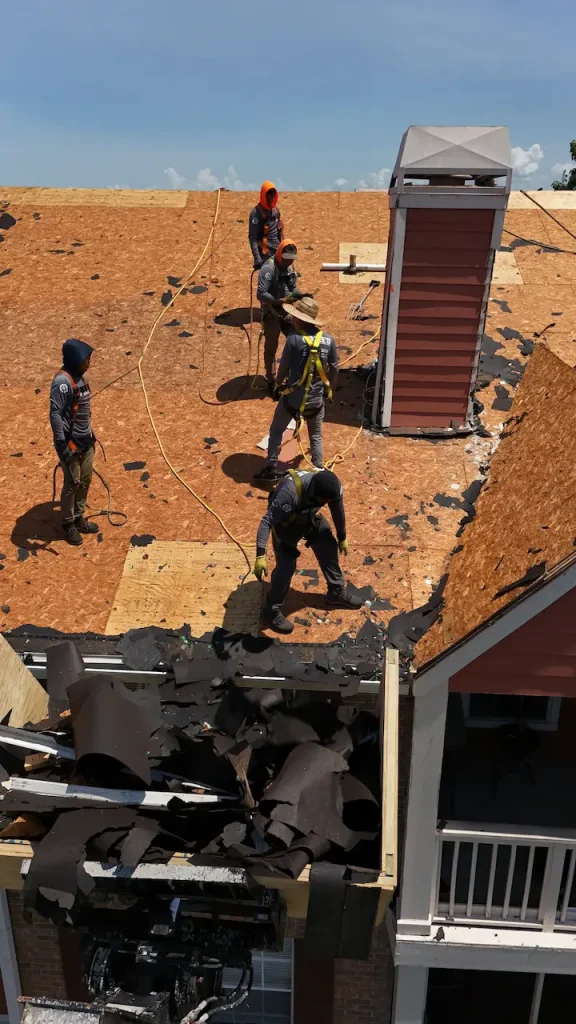
On repairs we treat that area like a deck issue, not a shingle issue. If the sheathing is compromised, we cut back to sound material and patch with matching thickness, then re-shingle that course correctly.
Old plank decking and patchwork framing make fasteners act weird
A lot of Sanford housing stock still has sections of 1x plank decking, sometimes mixed with later plywood patches from additions or previous repairs. Planks move differently than sheet goods. They shrink across the width, they cup, and they leave gaps that open and close with the seasons.
If a nail lands near the edge of a plank, it can feel solid on install day and then lose grip as that board dries and pulls away. If a plank cups, it can push the nail head up without the nail ever “backing out.” The deck is doing the lifting.
We also see framing transitions where an addition ties into an older truss or rafter system. The roof planes meet, but the framing stiffness is not the same. That creates a hinge line. The shingles bridge that hinge, and the nails at that line take more movement than the field.
On a proper repair we locate the pattern. If pops are marching along a line, we look for a framing change, a plank seam, or a repaired deck joint. Then we fasten for that condition, sometimes adding blocking under a seam so the deck is supported and the nail has real bite.
What a proper nail pop repair looks like, not a dab of cement
If you only press the shingle down and smear mastic, you are leaving the raised nail and the enlarged hole in place. It will telegraph again once the roof heats up.
A repair that lasts has a few steps.
The details we follow on a typical asphalt shingle repair
- Lift the shingle carefully and break the seal without tearing the mat.
- Pull the popped nail, do not drive it deeper into soft wood.
- If the hole is wallowed out, move the fastener location and set a new galvanized roofing nail in solid decking.
- Re-nail in the manufacturer nail zone, usually just below the adhesive strip, so the shingle is clamped where it is built to be clamped.
- Seal the lifted area with a small amount of asphalt roof cement under the tab, then press and weight it until it grabs.
If we find the deck is punky, we stop and address that. No amount of sealant fixes rotten sheathing. We will cut and patch the deck with the same thickness panel, then restore the underlayment and shingles.
This is also where we look for collateral damage, like granule loss from repeated flexing or a cracked shingle at the nail line.
Nail pops can be a leak path even before you see a ceiling stain
Homeowners often call after they see a spot on drywall. The roof has usually been taking water longer than that. A nail pop creates a tiny high point where water can slow down, then get pushed sideways under a shingle tab. (If you are chasing a stubborn drip, this ties into why your Sanford roof still leaks after repairs.)
The first thing we look for is a shiny nail head, or a dark ring around it where water has carried dirt. On architectural shingles, you might not see the head, but you will see a raised bump and a broken seal line. After a heavy summer storm, that is enough to wet the felt or synthetic underlayment. If the underlayment is older 15 pound felt, it can wrinkle and lose its lap seal over time. If it is synthetic, it resists wrinkling but water can still track along fastener penetrations.
Inside the attic, the sign is often a small black dot on the underside of the deck, right at a nail tip, or a rust stain on a nail shank. That can show up months before a ceiling stain.
If you catch nail pops early, the repair stays localized. If you wait until the deck softens, the fix turns into sheathing work and a larger shingle replacement area.
Yearly maintenance keeps nail pops from turning into deck replacement
Nail pops are one of the best arguments for a yearly maintenance program, because they are easy to miss until they are not. We do not need to be up there every month. Once a year, timed after storm season or before the long summer heat sets in, is usually enough to catch the early lifts.
Our checklist is plain. We walk the roof, we look for raised tabs, we check the high-sun exposures, and we pay attention to slopes over garages where heat builds up. We also look at previous repair areas. A pop that returns in the same spot tells us the deck is compromised or the framing is moving.
We also check gutters and downspouts while we are there. Overflowing gutters dump water back onto the eave, and repeated wetting at the edge can swell the deck and start the first pops near the drip line.
If you are in Sanford FL and your roof is past 10 years, a yearly look is not busywork. It is how you keep small fastener issues from becoming soft sheathing, interior stains, and bigger restoration work. (If you want to see how we think about this stuff across the year, start with preventive roof maintenance, and if you are planning ahead, read preparing your roof for hurricane season in Sanford.)
Key Takeaways
- Nail pops usually come from deck movement and loss of nail bite, not a “bad shingle.”
- OSB edge swelling and softened plywood around an old wet spot can turn a round nail hole into an oval that will not hold.
- Re-driving the same nail and smearing mastic is a short-term patch, a lasting repair relocates the fastener into solid decking and re-seals the tab.
- Mixed decking (1x planks plus plywood patches) and framing transitions can create repeat pop lines that need blocking or deck patching.
- Early signs show up in the attic as dark dots or rust at nail tips, often before you see a ceiling stain. (More examples here: roof leak signs.)
Conclusion
If nail pops keep coming back, the roof is telling you something is moving or something underneath is no longer solid. We treat it that way. We find the pattern, we check the deck, and we fix the fastener and the wood it is supposed to hold, then we put the shingles back the way the manufacturer intended.
If you want us to take a look, we can do a focused inspection and show you what we are seeing, including any soft spots in the sheathing and any repeat areas that need attention. That is the difference between chasing bumps around the roof and actually stopping them.
References
- National Roofing Contractors Association (NRCA): contractor standards, technical bulletins, and best-practice details. https://www.nrca.net/
- GAF: shingle installation instructions, nail line placement, and warranty documents for their products. https://www.gaf.com/en-us
- Owens Corning: shingle specs, fastening requirements, and published installation guides. https://www.owenscorning.com/en-us/roofing
- NOAA (National Oceanic and Atmospheric Administration): storm tracks, rainfall data, and local weather records we reference for Sanford-area conditions. https://www.noaa.gov/