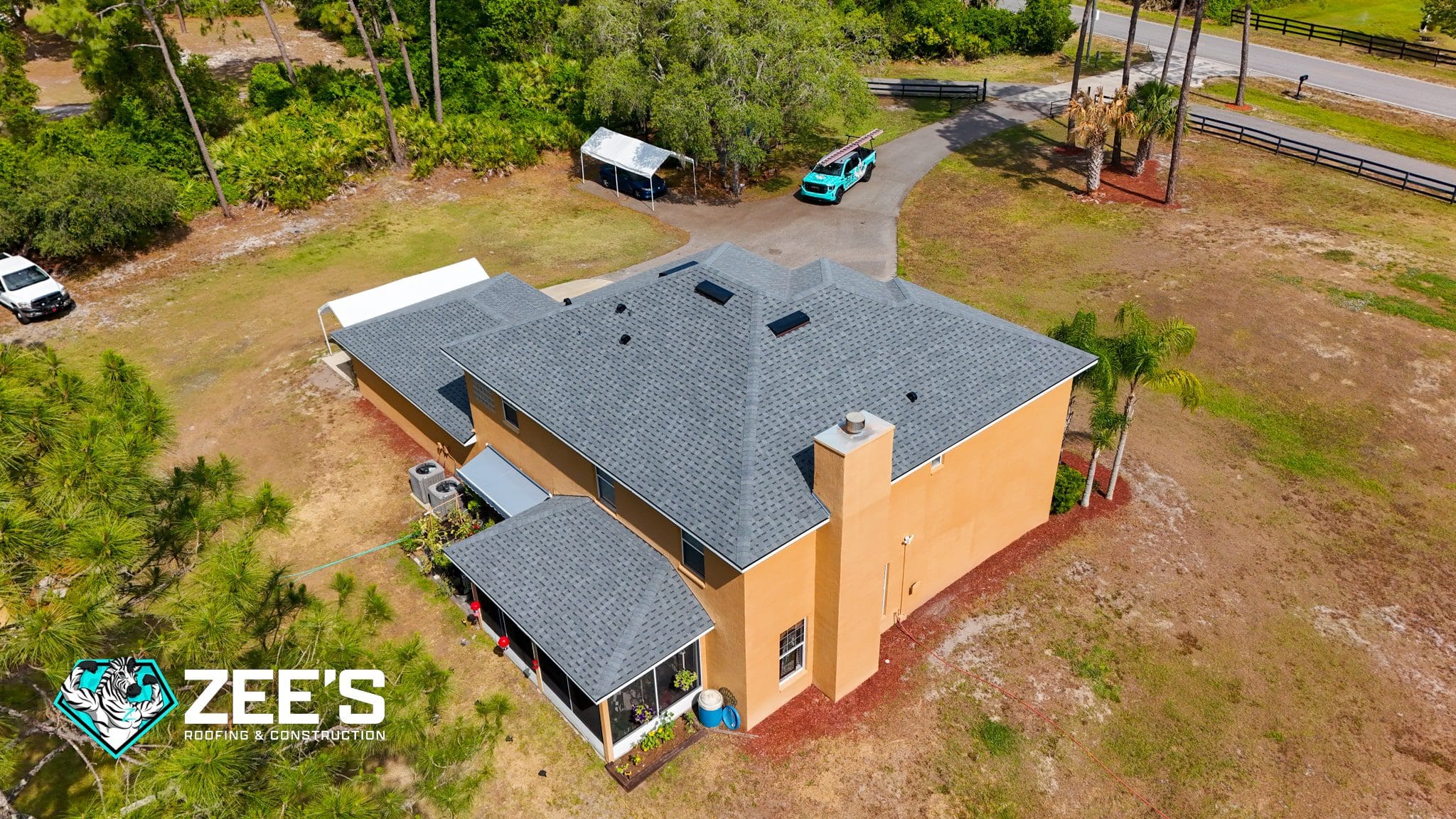
Alot of roof trouble in November doesn’t look like “weather” at all. It’s that pattern we get in Central Florida where the radar is clear at breakfast, the sun cooks the roof by lunch, then a pop-up shower rolls through at 3:30 and you’ve got dew settling heavy again by midnight. Homeowners see a crew start tear-off on a “nice” day and assume the house is exposed all afternoon. That’s not how we run it.
Dry weather windows matter because roof work is a sequence. You can’t skip steps, and you can’t leave a deck open and hope the next cell misses you. The goal is simple: keep the structure dry while the work is active, even if the forecast shifts. That means planning the tear-off footprint, staging underlayment, and getting the roof dried-in the same day, then coming back for detail work once the shell is tight.
Pop-up showers and overnight dew hit an open deck fast
A late-fall “quick shower” can dump enough water to find every low spot on a roof deck. On a 4/12 or 5/12 slope, water still moves, but it also has time to sneak sideways at seams, around nail holes, and along plywood joints. Once it’s under the surface, it shows up where you don’t want it, stained drywall, swollen baseboards, wet insulation.
Dew is quieter but it matters. Overnight, the roof surface cools and moisture condenses. If the deck is exposed, that moisture sits on wood fibers and between plies. OSB is the one that tells on you first, the edges swell, the strands lift, and you lose a flat nailing surface. Plywood handles wetting cycles better, but repeated damp mornings still raise grain and can telegraph through shingles.
That’s why we don’t treat “no rain in the forecast” as permission to open the whole roof. For roof repair Sanford FL projects, we plan for a surprise shower and a wet morning start, because that’s the normal pattern this time of year.
We size tear-off to what we can dry-in the same day
The biggest protection decision is how much roof gets opened at once. We don’t chase speed by stripping everything down to the deck and hoping we beat the weather. We measure the roof, look at valleys, dormers, and any dead valleys that trap water, then we break the work into sections we can control.
On most homes, that means a defined tear-off area that can be covered with underlayment before the afternoon instability shows up. We stage the underlayment rolls, cap nails, and flashings on the ground first, then they go up as soon as the deck is clean. If we’re replacing sheathing, we cut back to the center of the rafter so every sheet lands on solid framing. Typical roof sheathing is 7/16 inch OSB or 1/2 inch plywood, and we match what’s there unless the framing calls for an upgrade.
We also watch the clock. If the deck is still open by early afternoon, we’re behind, and we adjust. Smaller tear-off, faster dry-in, then finish details the next clear window. The house stays protected, that’s the point.
Underlayment choice and fastening decide how “dry” dry-in really is
Dry-in is not a vibe. It’s a specific assembly that has to shed water and stay put in wind. We use underlayments that are meant for Florida roofs, and we fasten them like they’re going to see a gust at the wrong time, because they will.
For many repairs and re-roofs, we use a synthetic underlayment rather than basic 15 lb felt. Synthetics don’t wrinkle the same way when they get damp, and they hold up better if we get a shower before shingles go on. At eaves and valleys, we often add a self-adhered peel-and-stick membrane (ice and water style) as a secondary seal. Even though “ice dams” aren’t our issue here, that membrane is excellent at stopping wind-driven rain that backs up at a valley or around a nail line (see wind-driven rain leaks).
Fasteners matter. Cap nails or cap staples spread the load and reduce tearing. Plain nails through synthetic can zipper in wind. We lap underlayment properly, 4 inches on horizontal laps is a common minimum, and we keep laps shingled so water runs over, not under.
If you ever watched a tarp flap itself to pieces, you already understand why fastening and laps are the difference between “covered” and “protected.”
Valleys, penetrations, and walls get sealed before we chase the field
Most leaks during an active roof job don’t come from the middle of the roof. They come from transitions. Valleys, plumbing vents, step flashing at a wall, a skylight curb, that’s where water concentrates, and that’s where a short shower can do real damage.
We handle those details early. On a valley, we don’t leave bare wood and promise we’ll “come back later.” We’ll install valley membrane and set the valley metal or prep the closed-cut valley layout before the field shingles run up to it (see roof valleys packed with oak leaves). On plumbing vents, we check the pipe size, 3 inch PVC is common, and we use the correct boot flashing and sealant where required (see why roof vent caps start dripping). A cracked neoprene boot collar is a common failure point, and it gets worse after summer UV.
At walls, step flashing is the workhorse. It has to be layered with the shingles, one piece per course, not a long strip that relies on caulk (see roof flashing problems). If there’s stucco or siding, we look for proper kickout flashing at the bottom so water doesn’t dump behind the cladding.
Doing the details first is slower on paper. In real weather, it’s what keeps the inside dry.
Morning moisture changes how we start: foot traffic, adhesives, and staging
Late fall mornings can be slick even if there’s no rain. Dew sits on shingles and underlayment, and a roof that felt fine at 2 pm yesterday can be a skating rink at 7 am. That changes the start of the day.
We don’t rush foot traffic on wet surfaces. It’s a safety issue, and it’s also a quality issue. Scuffed underlayment, torn laps, and crushed shingle edges happen when crews try to “work through” a wet roof. We’ll stage materials and set up fall protection, then we start on areas that dry first, usually the east-facing slope once the sun is up.
Adhesives and sealants also have limits. Many roofing sealants and peel-and-stick membranes want a clean, dry surface and a minimum temperature, often around 40°F to 50°F depending on the product. We’re not usually fighting freezes here, but cool mornings can still slow adhesion, and dew can flat-out prevent a membrane from bonding.
So we wipe, we dry, we prime where the manufacturer calls for it, and we don’t pretend wet is close enough. That’s how you avoid a membrane edge lifting two weeks later.
We keep water moving off the roof, gutters and temporary drainage matter
During active work, the roof doesn’t shed water the same way it does when it’s finished. Underlayment is smoother than shingles, and water moves faster. If downspouts are clogged, or a gutter is pitched wrong, that extra flow can overflow right where you don’t want it, behind fascia, into soffit, down a wall.
We look at the drainage before we open things up. Gutters get cleared so they can actually carry water (see roof granules in gutters). If a run is holding water because it’s back-pitched, we note it and address it as part of the exterior work. A typical gutter slope is subtle, but it has to be there. If water sits, it breeds debris, and during a shower it overflows.
On some jobs we’ll temporarily redirect discharge so it doesn’t dump at a corner that’s already vulnerable. That can be as simple as making sure the downspout is attached and pointed away from the foundation line.
This is also where perimeter walls and waterproofing tie in. If you’ve got stucco cracks, failed sealant at penetrations, or water staining at the top of a wall, roofing and exterior waterproofing have to work together. Keeping bulk water controlled during the roof phase prevents a lot of collateral damage.
How we schedule around late-fall forecasts, and what we need from you
Forecasts in November are better than summer, but they still miss the pop-up shower. We schedule roof repair work in Sanford FL around probability, not promises. If there’s a higher chance of a late-day cell, we plan to be dried-in before that window. If the next day is clearer, we’ll push detail-heavy work like counterflashing, paint touch-ups, and final sealing to that day.
What we need from the homeowner is straightforward. Clear the driveway so materials can land close to the house. Keep pets inside during tear-off. Let us know about any attic access issues, low branches, or soft spots in the yard that affect ladder placement. If you have a condo association, we also need to know the approval chain up front, because delays usually come from paperwork and access, not the shingles (see HOA roofing contractor).
If we find wet decking or stained trusses, we’ll show you. Wet wood needs time and airflow, and sometimes that means we pause and let it dry before we trap it under a new system.
A roof is a weather barrier. Our job is to keep it acting like one even while it’s being rebuilt.
Key Takeaways
- Pop-up showers can push water sideways at seams and nail holes, especially around valleys and penetrations.
- Exposed OSB edges can swell after a single wetting cycle, which is why we limit how much deck is open at once.
- Proper dry-in means synthetic underlayment with correct laps (commonly 4 inches) and cap-fastened attachment that resists tearing in wind.
- Valleys, vent boots, and step flashing get addressed early because that’s where short showers cause the most damage.
- Dewy mornings affect safety and adhesion, we wait for surfaces to dry and follow product temperature and moisture requirements.
- Clear gutters and working downspouts reduce overflow during active work, especially while the roof surface is temporarily smoother than shingles.
Conclusion
Dry weather windows aren’t about finding a perfect week. We build a plan that assumes the weather will do what it does here, clear mornings, damp surfaces, and a surprise shower that shows up right as you think you’re safe. The difference between a clean job and a mess inside the house is sequencing, how much we open, how fast we dry-in, and whether the details get sealed before the field gets pretty.
If you’re seeing a leak, a soft spot, or staining that showed up this fall, don’t wait for a “better season.” Get us out to look at it, walk the roof, check the attic, and map a repair that keeps the structure protected while the work is happening (see ceiling stains that show up in Sanford each fall and why your Sanford roof still leaks after repairs).
References